
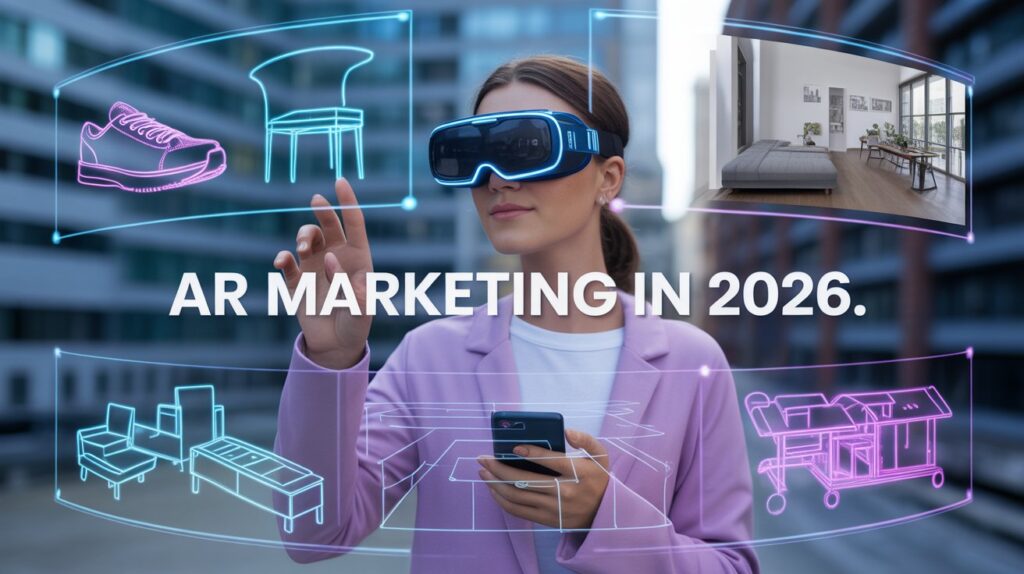
Introduction: Looking Ahead to 2026
Not long ago, buying something online felt like a gamble. You’d scroll through flat product photos, squint at size charts, and hope for the best. Sometimes it worked out. Sometimes… not so much.
Fast forward to 2026, and that gamble might finally disappear. Why? Because marketing is about to shift from showing products to letting us live them. The technology making that happen is Augmented Reality (AR).
Now, we’ve heard about Virtual Reality (VR) for years — those bulky headsets that promise other worlds. Cool, yes, but let’s be honest: how many of us actually own one? AR, on the other hand, is already in our hands. It’s in our phones, our tablets, and very soon, those sleek AR glasses that companies are racing to perfect.
That’s why AR isn’t just another “buzzword.” It’s the upcoming 2026 trend that businesses can’t afford to ignore.
Why AR Marketing Will Matter in 2026
1. From Watching to Doing
Scrolling past static ads is boring. Customers are tired of being passive. By 2026, people will want to test-drive your brand — literally.
Nike already lets sneakerheads try on shoes virtually.
Ikea has an app that drops furniture into your living room.
These aren’t futuristic ideas; they’re here now. By 2026, this won’t be a nice-to-have — it’ll be expected.
2. Faster Decisions, Less Doubt
Raise your hand if you’ve ever abandoned an online cart because you weren’t quite sure. We all have.
AR closes that gap. If you can see that sofa in your actual living room or that lipstick shade on your actual face, you’re not hesitating. You’re clicking “buy.”
3. AI + AR = Personalized Magic
Here’s where it gets interesting. AR by itself is fun. But pair it with AI, and suddenly it’s yours.
Your color.
Your size.
Your style.
By 2026, AI-driven AR will know your taste so well that it can show you the version of a product you didn’t even know you wanted — until you see it.
Who Stands to Win Big?
🛍 Retail & E-Commerce
Trying before buying will no longer be a privilege of in-store shopping. It’ll be the online standard.
🏠 Real Estate
Imagine house-hunting from your couch — walking through a property, switching wall colors, moving furniture, all before booking a visit. That’s 2026 real estate.
🎓 Education & Training
Forget PowerPoints. Students will step inside lessons.
A biology class could let you hold a 3D heart in your hand.
Corporate training won’t just be about PowerPoints and roleplay anymore.
Imagine employees practicing real-world challenges in a safe, simulated AR environment — negotiating with a virtual client, handling a customer complaint, or running through emergency drills — all without ever leaving the office.
🎤 Events & Exhibitions
Forget the long queues and rushed presentations.
By 2026, attendees will simply scan a QR code, step into an AR booth, and instantly experience a brand’s story — immersive, interactive, and on their own terms.
The Tech Powering It
Meta Spark Studio & TikTok AR → filters that once made funny faces are now shaping shopping journeys.
Google ARCore & Apple ARKit → bringing AR tools to billions of devices already in people’s hands.
The Hard Truth Nobody Talks About
It’s Expensive: Building high-quality AR isn’t cheap. Think 3D models, design teams, and tech upgrades.
It Must Work Everywhere: iOS, Android, wearables — if it glitches, people won’t forgive it.
Data = Trust: Customers will share more data, but they’ll also expect transparency. Cross that line, and you lose them.
💡 The smartest move? Use 2025 as your sandbox year. Test ideas, make mistakes, refine, so you’re ready when the wave truly hits.
Final Word
2026 isn’t here yet, but the shift is already happening. Augmented Reality will reshape marketing just like social media did a decade ago.
For early movers, AR will be a growth engine.
For those who wait, it’ll be a wake-up call.
The bottom line? Start experimenting today. Because when 2026 hits, customers won’t be asking whether you use AR. They’ll be asking why you don’t.