arshgrowvinci

The Future of Digital Marketing: What to Expect in 2026

Introduction: The Next Wave of Digital Transformation With 2025 right around the corner, the door opening to a brand-new era in digital marketing may be more if not less closed. Ai, automation, personalization and immersion are no longer futuristic buzzwords, but current tools making up the future of marketing. Here at GrowVinci we predict 2026 to be the year when brands move beyond digital presence, to digital intelligence — building campaigns that can think, learn and connect on a human level. 1️⃣ Everything Will Be Driven by Artificial Intelligence AI is already changing the way brands analyze data, predict trends and target consumers.Smart chatbots and voice assistants, AI-driven real-time campaign optimization – AI has become the quiet player in marketing success. Marketers will increasingly count on predictive analytics — predicting what customers want and providing them solutions before they even ask. 💡 GrowVinci Insight: Use AI-driven tools to analyze audience mood, timing and intent — that’s how premium brands are going to win loyalty. 2️⃣ Personalization Will Be the Queen of the Game Generic marketing is dead.By 2026, consumers seem to want experiences that are tailored just for them — custom offers, messaging and recommendations across all platforms. Those that ace data-driven personalisation will experience higher engagement, retention and trust among brands. 📊 Fact:80% of consumers report that they’re more likely to do business with brands offering personalized experiences. 3️⃣ The Age of Voice and Visual Search Typing is out, talking and snapping are in.Alexa, Siri and Google Lens, will all lead 2026 voice and visual search marketing. Businesses will have to move from SEO (Search Engine Optimization) to AEO (Answer Engine Optimization), optimizing for spoken, rapid and visual answers. 4️⃣ Video & Interactive Content Will Take The Spotlight Short-form video, AR try-ons, and interactive ads remain key in engaging users.Platforms like Instagram, YouTube and Meta Horizon will blend entertainment and commerce, allowing consumers to try products before making purchases. 🕶️ Trend Watch:Look for immersive storytelling to shape digital brand identity. 5️⃣ Privacy and Ethics Will Be the Trust Levers While trust is tied to many other things (social proof, great products), it ultimately always comes back to privacy (we heard this a lot).As governments put tight enforcements on what people can do with behavioural data, we will see ethical marketing become the backbone of all digital strategies. Marketers have to find a middle ground between personalization and respecting data borders.Transparency in data use, cookie-less targeting and permission-based marketing will become more credible. 🔒 GrowVinci Philosophy:We craft privacy-respecting, GDPR-ready campaigns to make the most of your budget. 6️⃣ Automation and Omni-Channel Experiences It’s not about having own 100 different tools in their box in 2026, it’ll be a single journey.This marketing automation will link the ads, emails, WhatsApp and CRM systems all the way through from click to conversion. 🤖 Result  Response times and tracking improve, customers are more satisfied. Conclusion: The Future Belongs to the Adaptive The digital future isn’t about new technology — it’s about a thoughtful approach to adapting in this age of the algorithm.

The Future of Digital Marketing: What to Expect in 2026 Read More »
The Faster Than Ever Shift to Digital: 7 Trends Shaping Marketing in 2025 🚀

The Faster Than Ever Shift to Digital If you’re not sure how a tent fits onto the internet, then where even are we? The landscape of digital marketing changes at lightning speed. What succeeded in 2023 might already be out of date by 2025. As technology changes and user behavior changes along with it, brands that adapt early have a considerable advantage. For business owners, marketers, and content creators alike, keeping up with digital marketing is a must.Here are the best 7 trends that define 2025 — and how you can ride them to boost your online brand. 1️⃣ Artificial Intelligence-Driven Marketing is Going Mainstream Artificial Intelligence (AI) is no longer just a buzzword, it’s the new face of digital marketing. From AI chatbots to predictive analytics and content creation tools, AI is enabling businesses to automate, analyze and customize campaigns in ways they never could before. Pro Tip: Marketers are using tools like ChatGPT, Jasper and Midjourney to create copy, graphics and customer replies for ads in seconds — getting back hours to focus on strategy instead. 2️⃣ Short-Form Video, Still King of the Internet Reels, Shorts and TikToks remain the kingmakers of brand visibility. Users favor short interesting content — and platforms are prioritizing it. In 2025, brands that blend storytelling + authenticity + fast-paced visuals will drive more engagement. Test: Use 15-30 second behind-the-scenes, customer stories, or quick tips to maintain relevancy and relatability. 3️⃣ Voice Search Optimization is Exploding 🎙️ Voice searches are also starting to dominate how users look for information online thanks to voice assistants like Amazon’s Alexa, Apple’s Siri and Google Home. That means your SEO strategy needs to change — you will want to be in top results for conversational searches and long-tail keywords that look like “best digital marketing company near me” or “how to boost Instagram engagement fast.” 4️⃣ WhatsApp Marketing is Turning out to be a Game-changer 💬 Whatsapp has emerged as a new marketing channel with more than 2 billion monthly active users. They use it for messages, promotions, updates and even personalised support through the WhatsApp Cloud API. FYI: WhatsApp has an open rate of upwards of 90% which far exceeds email marketing. 5️⃣ Influencer Collaborations Will Get Smarter 👩‍💻 Influencer marketing is no longer confined to big names — micro-influencers with smaller but highly engaged audiences are getting real results. What’s Breaking: Brands today have analytics, UTM links and ROI-based deals to monitor the success of their sponsorship instead of two sets of tires. 6️⃣ Data Privacy and Transparency Is More Important Than Ever That brings us to our data privacy and transparency You will be evaluated with a block of established factors. Consumers are becoming increasingly aware of how their data is employed. In 2025, brands that offer transparency, are on a secure system and communicate data use (and potential uses) like GDPR compliance will earn customer trust and loyalty. The Final Word Brands that play with AI, automation and creativity story telling will win the digital race. If you want to stay ahead in this rapidly changing world — pay attention to learning, adapting and evolving.

The Faster Than Ever Shift to Digital: 7 Trends Shaping Marketing in 2025 🚀 Read More »

GrowVinci 2025: The Future of Digital Growth and Brand Acceleration

One week a reel goes viral; the next week, the same kind of post barely gets seen.Algorithms change, trends fade, and every “expert” online seems to say something different. At GrowVinci, we’ve lived through that chaos too — and we’ve learned something important:Real growth doesn’t come from chasing every trend.It comes from clarity — knowing your audience, having the right tools, and keeping all your digital efforts connected. That’s what we help businesses do.We’re not here to sell you a “package.”We’re here to build a system that actually brings results — one that keeps working long after the campaign ends. 💡 What Makes GrowVinci Different We don’t jump straight into ads or design work.First, we sit down (virtually or in person) and talk about your brand —what’s working, what’s frustrating, and what you really want to achieve. Once we get that, everything else flows naturally: the website design the ad strategy the messaging the automation No overcomplication. No buzzwords.Just an honest process that makes sense. 🔍 What We Actually Do 1️⃣ Websites That Do Their Job Let’s be real — most websites look good but don’t do much.We focus on building sites that convert — clean, quick to load, mobile-friendly, and built with real users in mind.Every button, headline, and layout is there for a reason — to move your visitor one step closer to taking action. 2️⃣ Meta Ads That Actually Work We’ve all seen flashy ads that get likes but no leads.Our approach is simple — we create ads that connect emotionally, not just visually.We test, tweak, and improve constantly, focusing on what brings you the best return, not the biggest impressions. It’s less about “looking cool” and more about what converts. 3️⃣ Google & YouTube Ads: The Right Audience, The Right Time When someone is actively searching for what you offer, that’s your golden moment. 4️⃣ WhatsApp Marketing That Feels Personal People are tired of spam emails and cold calls.But WhatsApp? That’s personal space. We use it carefully — to: share updates recover abandoned carts answer quick questions send reminders All automated, but written in a way that sounds human.Over time, you start seeing traffic that sticks around — because it’s people who actually care about what you offer. ⚙️ How We Usually Work Our process isn’t complicated.We usually break it down like this: Month Focus What You’ll See Month 1 Discovery & Setup A clear plan and organized systems Month 2 Campaigns & Testing More engagement, better reach Month 3 Scaling Steady growth and measurable ROI By the end of 90 days, most clients tell us the same thing —“We finally know what’s working.” 💬 Why Our Clients Stick Around Most of our clients come through word of mouth — that probably says a lot.We don’t disappear after a campaign.We stay in touch, share ideas, and keep improving what’s already working. Because we handle everything in one place — design, ads, SEO, and automation —our clients never have to juggle five different agencies again. We are a small team, but we care deeply.That creates difference. 🎯 Our Mission Our mission is to help businesses grow in a way that feels genuine —with strategies that make sense without stress. If you’re done with overcomplicated marketing and just want a clear path that works, let’s talk.We’ll look at where you are, where you want to go, and how we can help you get there. 📞 Contact Us Phone: +91 78888 29489Email: info@growvinci.comWebsite: www.growvinci.com

GrowVinci 2025: The Future of Digital Growth and Brand Acceleration Read More »

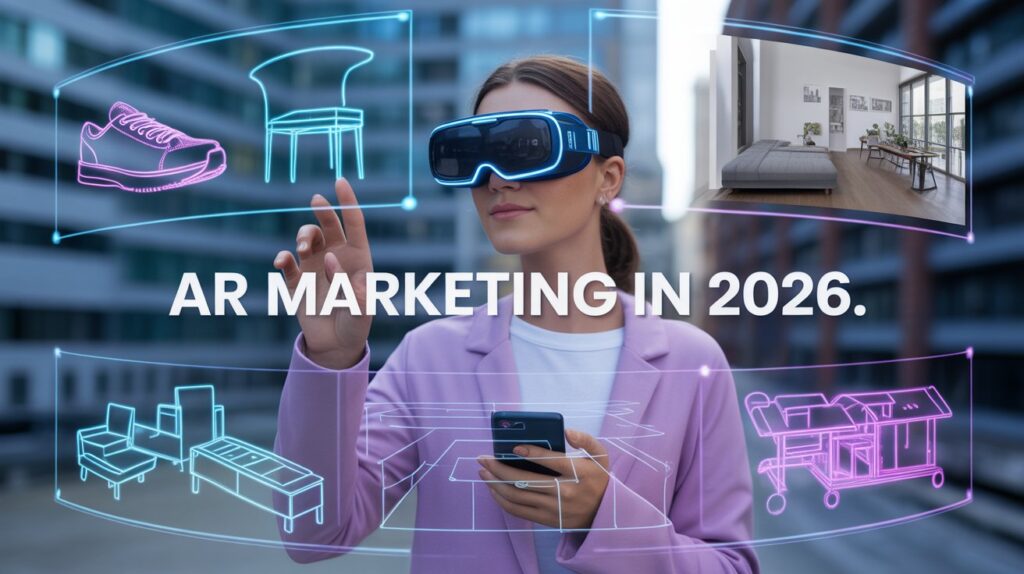
Augmented Reality Marketing in 2026: The Next Big Wave of Digital Engagement

Introduction: Looking Ahead to 2026 Not long ago, buying something online felt like a gamble. You’d scroll through flat product photos, squint at size charts, and hope for the best. Sometimes it worked out. Sometimes… not so much. Fast forward to 2026, and that gamble might finally disappear. Why? Because marketing is about to shift from showing products to letting us live them. The technology making that happen is Augmented Reality (AR). Now, we’ve heard about Virtual Reality (VR) for years — those bulky headsets that promise other worlds. Cool, yes, but let’s be honest: how many of us actually own one? AR, on the other hand, is already in our hands. It’s in our phones, our tablets, and very soon, those sleek AR glasses that companies are racing to perfect. That’s why AR isn’t just another “buzzword.” It’s the upcoming 2026 trend that businesses can’t afford to ignore. Why AR Marketing Will Matter in 2026 1. From Watching to Doing Scrolling past static ads is boring. Customers are tired of being passive. By 2026, people will want to test-drive your brand — literally. Nike already lets sneakerheads try on shoes virtually. Ikea has an app that drops furniture into your living room. These aren’t futuristic ideas; they’re here now. By 2026, this won’t be a nice-to-have — it’ll be expected. 2. Faster Decisions, Less Doubt Raise your hand if you’ve ever abandoned an online cart because you weren’t quite sure. We all have. AR closes that gap. If you can see that sofa in your actual living room or that lipstick shade on your actual face, you’re not hesitating. You’re clicking “buy.” 3. AI + AR = Personalized Magic Here’s where it gets interesting. AR by itself is fun. But pair it with AI, and suddenly it’s yours. Your color. Your size. Your style. By 2026, AI-driven AR will know your taste so well that it can show you the version of a product you didn’t even know you wanted — until you see it. Who Stands to Win Big? 🛍 Retail & E-Commerce Trying before buying will no longer be a privilege of in-store shopping. It’ll be the online standard. 🏠 Real Estate Imagine house-hunting from your couch — walking through a property, switching wall colors, moving furniture, all before booking a visit. That’s 2026 real estate. 🎓 Education & Training Forget PowerPoints. Students will step inside lessons. A biology class could let you hold a 3D heart in your hand. Corporate training won’t just be about PowerPoints and roleplay anymore. Imagine employees practicing real-world challenges in a safe, simulated AR environment — negotiating with a virtual client, handling a customer complaint, or running through emergency drills — all without ever leaving the office. 🎤 Events & Exhibitions Forget the long queues and rushed presentations. By 2026, attendees will simply scan a QR code, step into an AR booth, and instantly experience a brand’s story — immersive, interactive, and on their own terms. The Tech Powering It Meta Spark Studio & TikTok AR → filters that once made funny faces are now shaping shopping journeys. Google ARCore & Apple ARKit → bringing AR tools to billions of devices already in people’s hands. The Hard Truth Nobody Talks About It’s Expensive: Building high-quality AR isn’t cheap. Think 3D models, design teams, and tech upgrades. It Must Work Everywhere: iOS, Android, wearables — if it glitches, people won’t forgive it. Data = Trust: Customers will share more data, but they’ll also expect transparency. Cross that line, and you lose them. 💡 The smartest move? Use 2025 as your sandbox year. Test ideas, make mistakes, refine, so you’re ready when the wave truly hits. Final Word 2026 isn’t here yet, but the shift is already happening. Augmented Reality will reshape marketing just like social media did a decade ago. For early movers, AR will be a growth engine. For those who wait, it’ll be a wake-up call. The bottom line? Start experimenting today. Because when 2026 hits, customers won’t be asking whether you use AR. They’ll be asking why you don’t.

Augmented Reality Marketing in 2026: The Next Big Wave of Digital Engagement Read More »

Adaptive Marketing in 2026: The Strategy Every Business Needs to Survive

Introduction If you’re in marketing, you already know how exhausting it feels to keep up with everything. One week you’re learning Instagram’s new algorithm; the next, TikTok rolls out a feature that everyone swears is “the future.” Just when you start to see results, your competitors pivot, customers lose interest, and you’re left wondering what went wrong. That’s the reality of 2026. Marketing isn’t just changing—it’s speeding up. The winners in this game aren’t the ones who plan for six months and hope it sticks. They’re the ones who design adaptive systems—campaigns and workflows that bend, shift, and flex with the moment. At GrowVinci, we’ve worked with businesses who felt stuck in “catch-up mode.” They launched campaigns late, reacted slowly to trends, and ended up spending more for less return. The difference when they embraced adaptability was almost instant: campaigns stopped feeling like a gamble and started working like engines, consistently powering growth. Why Adaptability Is the New Marketing Superpower Think about this: when was the last time you searched something on Google? Chances are, last year you were typing. Today, maybe you asked ChatGPT, or Siri, or Bard. Tomorrow, you might hold up your phone camera and let AI identify the answer for you. That’s how fast things are moving. And that’s why adaptability matters. AI-first platforms are rewriting the rules: Google, Meta, and TikTok don’t just suggest—they predict. Your ad might be boosted or buried before you even notice. If you’re not adaptive, you’ll miss those signals. Customers expect personalization everywhere: We’ve all unsubscribed from generic emails that don’t “get us.” Adaptive marketing solves this by tailoring offers in real time—so no two people see the exact same thing. Trends die quicker than ever: Remember that viral Instagram sound you couldn’t escape last month? Chances are, it’s already gone. Adaptive systems let you jump in while it’s hot, not when the party’s already over. The truth is simple: adaptability isn’t a luxury anymore. It’s survival. The Four Pillars of Adaptive Marketing 1. Real-Time Data Integration Here’s the catch with traditional reports: by the time they land on your desk, the moment has passed. A bad campaign might have already drained half your budget. Adaptive marketing solves this with live dashboards that pull data across platforms—social, CRM, ads, even customer service chat. Instead of reacting in weeks, you adjust in hours. Imagine this: a campaign underperforms on Instagram but explodes on WhatsApp. With adaptive systems, you don’t wait for “end-of-month reporting.” The budget shifts instantly. 2. AI-Powered Testing Loops Marketers used to A/B test a headline, wait two weeks, and then declare a winner. Today, AI can test hundreds of combinations overnight and roll out the best version by morning. We saw this with a retail client at GrowVinci: they used to test three banner variations across 30 days. With AI-powered loops, we tested 300 variations in just a week. The result? 3. Dynamic Customer Segmentation Static personas—“Jane, 29, coffee-lover, lives in a city”—don’t cut it anymore. Customers are fluid. How Businesses Can Put Adaptive Marketing Into Practice Here’s what it looks like in action: Smart Funnel Automation: Instead of forcing everyone down one path, funnels adjust. Abandoned cart? Send a WhatsApp nudge. Reading blog posts? Offer a free guide first. The funnel bends to the user—not the other way around. Creative Refresh Cycles: Ads no longer sit for months untouched. Colors, CTAs, and designs refresh weekly based on real data. One of our fashion clients updates ad visuals every 10 days—customers always feel like something new is happening. Predictive Ad Spend Allocation: If one campaign is performing three times better than the others, why wait until Friday to shift money? Adaptive systems move funds instantly. We’ve seen businesses save lakhs this way. Voice & Visual Search Optimization: Imagine someone snaps a photo of sneakers and asks, “Find me this.” Or says, “Alexa, best marketing agency near me.” Adaptive brands are the ones who show up. Why GrowVinci Champions Adaptability We don’t just recommend adaptive marketing because it’s trendy—we’ve built it into our DNA. On WhatsApp Cloud API, our adaptive flows adjust depending on user responses. If someone clicks but doesn’t reply, we change the tone in the next message automatically. On Meta Ads, our testing loops cut wasted spend by 30%+ for several clients last year. That’s not a theory—it’s happening right now. In web development, we’re already preparing sites to be discoverable in AI-driven search engines, not just Google. One of our favorite success stories is from a small café that wanted to compete with larger chains. By embracing adaptive WhatsApp campaigns and micro-targeted ads, they doubled weekend bookings in just two months.

Adaptive Marketing in 2026: The Strategy Every Business Needs to Survive Read More »

Generative AI in 2025: Transforming Content Creation & Customer Engagement

Introduction Every once in a while, something new shows up in the tech world that doesn’t just make life a little easier — it flips the way businesses actually work. In 2025, that “something” is generative AI. Now, I know what you might be thinking: “AI again? Haven’t we been hearing about it for years?” True — but this time it’s different. It’s not just a trendy buzzword or a side experiment marketers play around with. It’s become part of the daily workflow. From drafting that blog you’ve been putting off, to designing social posts, to even helping customer support reply faster — AI is right there in the middle of it. But here’s what I find most interesting: it’s not about AI replacing creativity. It’s more like having an assistant who takes care of the heavy stuff, so humans can focus on what really matters — the ideas, the stories, and the emotional spark that actually connect with people.   Why Generative AI Is Making Noise in 2025 Think about how content marketing worked a few years ago. A team might spend a week drafting a blog, another week editing, then fight over headlines until everyone was exhausted. Campaigns took time, and testing ideas was expensive. Now? AI can: Draft a blog outline in minutes. Suggest 20 different ad headlines while you sip coffee. Generate design mockups faster than a freelancer can even open Photoshop. And yes — that’s amazing. But here’s the truth: if you just copy-paste AI’s output, your audience will scroll right past it. People are smart. They know when content feels flat. So, the real opportunity is using AI for speed and scale, and then using human creativity to inject life into it. Real-World Ways Businesses Are Using AI Right Now Let’s not stay theoretical — here are some ways I’ve seen generative AI actually reshape content and engagement this year: Blogging with a BackboneOne client of mine used AI to generate a blog draft on “top digital marketing trends.” The draft was… okay. Basic, generic, nothing you’d bookmark. But when we added real insights, personal opinions, and examples from their own campaigns, suddenly it felt authentic. The AI gave us a starting point, but the human touch made it readable. Social Media AdsAnyone who has run Facebook or Instagram ads knows the pain of guessing which caption will perform. With AI, you can test 10 headlines at once, analyze the data, and then decide which direction feels right. It takes the guesswork out but still leaves room for creativity. Customer Engagement & ChatbotsRemember the days when chatbots felt robotic? (“Hi, I am Bot. How may I assist you today?”) Those days are gone. With AI, chatbots now sound conversational. Sure, they’re not perfect — a frustrated customer will always prefer a human — but for FAQs and basic support, AI is already saving businesses hours every day. Design & Visual ContentI’ve seen design teams use AI tools to create quick ad mockups. Does the final version still need a human designer’s polish? Absolutely. But instead of starting from scratch, designers now start with a rough AI draft and refine it — which is a huge time-saver. Where Humans Still Win Here’s the danger: too many businesses are treating AI like a magic wand. They throw prompts at it and then hit publish. And that’s where they fail. Because here’s the hard truth: AI has zero life experience. It doesn’t know what it feels like to launch a campaign that flopped, or the excitement of a customer testimonial that makes you smile. It doesn’t know sarcasm, cultural nuance, or emotion the way humans do. Customers don’t connect with “data-driven personalization.” They connect with stories. They connect with real human voices, mistakes, and experiences. So, the winning formula in 2025 is simple:👉 AI for speed, scale, and structure.👉 Humans for trust, creativity, and connection. A Peek Into What’s Next If you ask me, we’re just scratching the surface. By 2026, AI won’t just help you create content — it’ll predict what your audience wants before they even think about it. Imagine logging into your marketing dashboard, and AI already has three campaign ideas ready because it noticed search trends shifting overnight. Sounds exciting, right? Also a little scary. But the businesses that learn to ride this wave now will be light years ahead of those who hesitate. Final Thoughts Generative AI isn’t some sidekick anymore. It’s right at the core of how content is created and how customers are engaged. But the biggest mistake brands can make is assuming AI can replace human creativity. Use AI as your co-pilot — the tool that handles the repetitive work — while you focus on the heart of the message. Because at the end of the day, people don’t remember how “optimized” your content was. They remember how it made them feel.

Generative AI in 2025: Transforming Content Creation & Customer Engagement Read More »

How AI-Driven Content Optimization is Changing SEO in 2025

Introduction Let’s be real—SEO isn’t what it used to be. There was a time when dropping in the right keywords and chasing backlinks was enough to climb the rankings. Those days are gone. Now it’s about how fast your site loads, how easy it is to read, and whether the content actually answers what people came for. And here’s where AI steps in. It’s not just another buzzword—AI has quietly become the co-pilot for writers, marketers, and business owners. In 2025, content optimization isn’t just technical; it’s strategic, fast, and more aligned with what both search engines and real people want. Let’s dig into how things are changing and, more importantly, what you can do about it. Why AI-Driven Optimization Matters It figures out intent, not just words. Search engines have gotten smart at reading between the lines. AI mirrors that—it helps you write for what people mean, not only what they type. It saves you time. Think of AI like a writing buddy that taps you on the shoulder while you draft: “Hey, that sentence is too long,” or “maybe add a subheading here.” Less editing later. It matches how we talk. More people search with their voice. If your content sounds stiff or overly formal, you’re missing those queries. It studies behavior. AI tools track whether readers scroll, bounce, or stay glued. That feedback shows you what’s working (and what’s boring them). Tools Worth Checking Out AI writing assistants (GPT-4, Claude, etc.) – Handy for sparking ideas or shaking off writer’s block. Just don’t copy-paste blindly. Content gap analyzers – Ever wonder why a competitor’s blog ranks above yours? These tools show you the topics you’ve overlooked. Readability checkers – Grammarly, Hemingway—basic but underrated. If your content is hard to read, it won’t perform. Simple as that. AI-generated visuals & alt text – Quick way to make posts more engaging and accessible. Plus, search engines notice. Semantic clustering tools – Instead of writing one lonely post, you group articles around a theme. Google loves it. What’s Different in 2025 Topic clusters everywhereInstead of chasing a single keyword, smart creators are building content hubs. One main guide, surrounded by sub-articles. AI helps map it all out. Voice-first optimizationThink about how people actually say things: “best Italian food near me” vs. “restaurants Italian.” That difference is where optimization is heading. Predictive SEO tipsSome tools practically hand you an outline—headings, FAQs, even what type of chart to use. Creepy? Maybe. Useful? Definitely. User experience = rankingsSpeed, mobile design, layout—Google’s watching. AI can highlight the weak spots before they cost you. Quick Wins You Can Try Now Don’t just pick keywords—dig into intent first. Then brainstorm a few possible titles. Keep articles skim-friendly: short sections, bullets, subheadings. Nobody reads walls of text. Add FAQs. They work for voice search and keep readers around longer. Make your site light and fast. Big images and clunky scripts kill rankings. Don’t ignore old content—refresh what’s slipping before it disappears completely. Watch Out For These Fluffy AI text. Readers can spot it. Always inject your own insights or examples. Shifting algorithms. SEO rules don’t sit still. Expect curveballs. Bad info. AI can sound confident but be flat-out wrong. Double-check facts. Tone balance. Over-optimized content sounds robotic. Too casual can feel unprofessional. Aim for the middle. Final Thoughts SEO in 2025 is about being useful, fast, and clear. AI can make the process smoother, but it’s not a replacement for your perspective or creativity. The sites that win will be the ones mixing tech efficiency with a human touch. At the end of the day, Google isn’t your only audience—people are. Write for them first, and let AI handle the polish.

How AI-Driven Content Optimization is Changing SEO in 2025 Read More »

Micro-Moments in 2025: How to Capture Attention in Seconds

Today’s world, you have very little time to spare. A single notification, a quick swipe, a peek at a trending reel, can create or shatter a brand’s ability to forge a bond with its audience. Welcome to the age of Micro-Moments in 2025. Those split-second decisions made with intent. Decisions made because someone wants to know, wants to go, wants to do, or wants to buy something. These micro-moments in time have become the focus of digital marketing strategies as we know them today. Brands that embrace the strategies and adapt to them will remain visible, trusted, and competitive. The focus of success in 2025 will rely on mastering these small but influential moments that guide instant customer decisions and base conversions. What is the meaning of Micro-Moments? “Micro-moments” is a term created by Google to characterize the many instances of users of a device needing to address a problem. Such instances occur frequently during the course of a day, and more often than not, they determine the course of action a user will take. Some of the more routine use case scenarios could include: Using the query “best laptop under 50,000” and considering a purchase before entering the store. Searching for “coffee shops near me” when in a new town. Viewing a 15 second product advertisement on Instagram or Tik Tok and deciding to purchase it. Requesting Alexa or Siri to “find the closest gym that has membership deals.” Although it is often the case that such instances are considered trivial, they in reality result in not only a shift in consumer behavior, but also affect an overall change in branding. Why Micro-Moments Matter in 2025 With the rise of AI personalization and more intelligent and effective search algorithms, micro-moments are no longer random; they are predictable and very precise. This is what makes them important for businesses this year: Faster Conversions: Research indicates that 70% of consumers take action within minutes of a micro-moment search. Higher Relevance: Google and social media platforms now focus on only hyper-relevant, quality content. The Price of Ignoring Micro-Moments in 2025: Erasure. Your audience will be captured and optimized by competitors. Mobile-First Behavior: more than 60% of the world’s traffic is through smartphones, and micro-moments are predominantly mobile. These stats prove that micro-moments are no longer optional; they are the new consumer engagement and brand visibility approach. How to Capture the Moment in Digital Marketing. In this new environment which is out of the ordinary for business we see that which is put forth is five key rules.   Today’s world, you have very little time to spare A single notification, a quick swipe, a peek at a trending reel, can create or shatter a brand’s ability to forge a bond with its audience. Welcome to the age of Micro-Moments in 2025. Those split-second decisions made with intent. Decisions made because someone wants to know, wants to go, wants to do, or wants to buy something. These micro-moments in time have become the focus of digital marketing strategies as we know them today. Brands that embrace the strategies and adapt to them will remain visible, trusted, and competitive. The focus of success in 2025 will rely on mastering these small but influential moments that guide instant customer decisions and base conversions.   What is the meaning of Micro-Moments? “Micro-moments” is a term created by Google to characterize the many instances of users of a device needing to address a problem. Such instances occur frequently during the course of a day, and more often than not, they determine the course of action a user will take. Some of the more routine use case scenarios could include: Using the query “best laptop under 50,000” and considering a purchase before entering the store. Searching for “coffee shops near me” when in a new town. Viewing a 15-second product advertisement on Instagram or Tik Tok and deciding to purchase it. Requesting Alexa or Siri to “find the closest gym that has membership deals.” Although it is often the case that such instances are considered trivial, they in reality result in not only a shift in consumer behavior, but also affect an overall change in branding.   Why Micro-Moments Matter in 2025 With the rise of AI personalization and more intelligent and effective search algorithms, micro-moments are no longer random; they are predictable and very precise. This is what makes them important for businesses this year: Faster Conversions → Research indicates that 70% of consumers take action within minutes of a micro-moment search. Higher Relevance → Google and social media platforms now focus on only hyper-relevant, quality content. The Price of Ignoring Micro-Moments in 2025 → Erasure. Your audience will be captured and optimized by competitors. Mobile-First Behavior → More than 60% of the world’s traffic is through smartphones, and micro-moments are predominantly mobile. These stats prove that micro-moments are no longer optional; they are the new consumer engagement and brand visibility approach.   How to Capture the Moment in Digital Marketing In this new environment which is out of the ordinary for business we see that which is put forth is five key rules: Be Present → Strengthen SEO, local search optimization, and social media presence. Be Pervasive → Optimize websites, landing pages and apps for speed. Users leave if loading time is over 3 seconds. Be Personal → Use AI-driven insights and remarketing to tailor experiences. Be Visual → Short-form video, carousels and infographics will outdo text in grabbing attention. Be Authentic → Build credibility with reviews, testimonials and transparent communication. In micro moments, speed, trust, and relevance are what secure the customer’s decision.

Micro-Moments in 2025: How to Capture Attention in Seconds Read More »

Paid vs. Organic Search: Finding the Right Balance

One of the biggest debates in digital marketing is the one over Paid vs Organic Search. On the one hand, there is the slow, steady, and reliable growth of organic search. On the other hand, the fast, targeted, and strong effectiveness of paid ads. So, which one is the best for your business? The reality, however, is not just “either/or.” The most successful digital strategies are not based on a single pillar, but rather on the balanced and integrated approach that combines the unique features of two. Here is a comparison between the advantages of each strategy and, most importantly, the ways that you could use to make them work in tandem. What Is Organic Search? Organic search stands for the unpaid results that appear on a search engine results page (SERP). Imagine the “10 best hiking trails” blog post that pops up when you type in the name of a new place to hike. The primary way of getting a first-class position in organic results is through the process of Search Engine Optimization (SEO). It also involves a variety of actions such as: Keyword Research: Finding the words and phrases your potential customer is. Content Creation: Producing content that can be used for searching solutions with the highest quality, relevance, and use. On-Page SEO: Fixing up the technical side of your website like meta descriptions, titles, and site speed. Link Building: Getting links from other reputable websites to raise your rank. The Pros of Organic Search Trust and Credibility: People most of the time consider organic results more reliable and authoritative because the rankings are awarded, not bought. Long-Term ROI: When you get high SEO, your content can continue to attract free visitors without paying for ads for months or years. Cost-Effectiveness: The long-term cost per click is practically free although some activities are required upfront (for example, content creation and tools usage). Sustainable Growth: SEO really solidifies your brand foundation, allowing you to gain and keep a good standing with the public over time. The Cons of Organic Search Time-Consuming: The road to a high organic rank is long and requires a lot of effort. It is a “slow burn” strategy. Algorithm Changes: Search engines are always upgrading their algorithms, and sometimes these upgrades lower your ranks and require you to adjust your plans. Intense Competition: It is almost impossible to get ranked for highly competitive keywords if there are already many companies are working in that market. Paid vs Organic Search: What Is Paid Search? Paid search, or Pay-Per-Click (PPC) advertising, is a scheme in which a company pays a search engine (like Google or Bing) to put their ad at the top or bottom of the SERP. These ads typically feature an icon marked “Sponsored” or “Ad”. You bid on keywords, and you only pay when a user clicks on your ad. The Pros of Paid Search The Pros of Paid Search Instant Visibility: Paid ads provide a business or promotion with a spot on the first page of search results straight away, this is very convenient for time-sensitive offers or new companies. Precise Targeting: You are capable of targeting specific demographics, locations, devices, or even the time of day, which gives you the exact control of your advertisement pool. Measurable Results: PPC programs have comprehensive analytics that allow you to monitor your impressions, clicks, conversions, and ROI easily and quickly. Flexibility and Speed: You have the option to try different keywords, ad copy, and landing pages rapidly, and to adjust your on-the-go campaign depending on the result you get. The Cons of Paid Search Ongoing Cost: As soon as you cease paying your ads disappear. Also, the cost per click can be high for competitive keywords. Less Credibility: A number of users who consciously ignore the paid ads specifically what they want to get organic results set. Dependency: Companies may become dependent on paid ads for web traffic, thus they will be the first to be seriously affected when the budget has to be cut or when rival competition gets tougher. Lorem ipsum dolor sit amet, consectetur adipiscing elit. Ut elit tellus, luctus nec ullamcorper mattis, pulvinar dapibus leo. Finding the Right Balance: The Synergy of Both You get the most benefit from search when you no longer consider paid and organic search as antagonists but rather as partners in crime. This is how you can conjure up a strategy that is not only in harmony but also dynamic: 1. Use Paid Search to Inform Your Organic Strategy PPC is an ideal way for you to test different ideas. Try out a paid campaign to compare the effectiveness of various keywords and ad copy in a short time. High click-through rate and conversions will tell you that the keyword is worth focusing on in your SEO content planning. Chiefly relying on statistics will actually spare you a lot of time and money as you will be investing in the content whose keywords you have already verified to be successful. 2. Leverage Paid Ads for Competitive or “Hard-to-Rank” Keywords There are some keywords you will never be able to rank for organically due to their high competitiveness especially if the competition is the big guys. So, rather than exhausting yourself with just getting ranked, get your paid ads to do the work for you and let the ad bring in quick visibility for the terms that are high in both value and competition. 3. Use Paid to Boost New or Time-Sensitive Content SEO can never be very quick. In cases such as a new product release, a time-limited offer, or a seasonal campaign, you obviously cannot rely on organic rankings as they will take their time to move upward. To get instant targeted traffic to your new article or landing page, initiate a paid campaign where the traffic can be directed. 4. Dominate the SERP with a Blended Strategy If besides a paid ad, an organic top-ranking result by your company is also exhibited to

Paid vs. Organic Search: Finding the Right Balance Read More »

What is Google’s Nano Banana & Why It’s Changing the Way We Edit Images

In the ever-evolving world of AI image tools, Google’s latest release—Nano Banana, officially known as Gemini 2.5 Flash Image—is making waves. From creative social media trends to serious concerns about image authenticity, here’s everything you need to know about this tool and why it matters. What Is Nano Banana? Nano Banana = Gemini 2.5 Flash Image, a new image generation & editing model from Google DeepMind. Google Developers Blog+2Tatler Asia+2 Launched around August 26, 2025, and integrated into Google’s Gemini app as well as AI Studio & other developer tools. Google Developers Blog+1 Designed to allow users to edit existing images (or combine multiple images), make realistic transformations via text prompts, maintain consistency of subjects’ appearance across edits, and more. Piktochart+3blog.google+3Tatler Asia+3 Key Features Here are some of the standout features that have people excited: Feature Description Character / Subject Consistency The tool keeps people, pets, or objects recognizable across edits. You can change background, outfit, pose, etc., and the subject still looks right. Piktochart+2blog.google+2 Prompt-Based Editing Using natural language, you can request edits such as “blur the background,” “remove a stain,” “change pose,” etc. No need for complicated manual masking or multi-step graphical editing. Tatler Asia+2Google Developers Blog+2 Multi-Image Fusion You can feed multiple images and combine them into one output—blend scenes, merge environments, or fuse elements from different photos. Google Developers Blog+1 Speed & Workflow Efficiency Compared to many tools, edits happen fast. Google emphasizes lower latency, smoother creative workflows. Piktochart+1 Watermarking / Attribution Every image edited or generated includes a visible watermark and also an invisible (digital) watermark—“SynthID”—to identify AI-generated or edited content. blog.google+2Fast Company+2 Why It Matters Here are some of the implications—good and challenging: Empowering More Creators: Because you don’t need advanced photo-editing skills, more people can generate high-quality images, visuals for social media, product mockups, or art. Piktochart+2Tatler Asia+2 Consistency and Brand Image: Businesses and content creators can maintain a consistent aesthetic—same look for products, brand assets, etc. Google Developers Blog+1 Speeding Up Design Work: Instead of multiple tools (Photoshop, etc.), many edits can now be done via prompts; design cycles can be faster. Google Developers Blog+2Piktochart+2 Concerns Over Trust & Authenticity: Because the edits are so seamless, Nano Banana raises concerns about deepfakes or manipulated images being passed off as real. Even for historical or news images. The watermarking helps, but trust is still an issue. Fast Company+2Tatler Asia+2 How to Use Nano Banana (Gemini 2.5 Flash Image) Here’s a quick guide for someone wanting to try it out: Get AccessUse the Gemini app, Google AI Studio, or via API/Vertex AI if you’re a developer. Google Developers Blog+1 Pick Your Image(s)You can start with an existing photo, or feed multiple images if you plan to combine elements. Write Prompts ClearlyExample prompts: “Change the background to a sunset beach.” “Make the person wear traditional Indian clothes.” “Blend this photo with another: me + my pet in a fantasy forest.”Clarity helps; the model responds to natural-language instructions. Piktochart+1 Iterate & RefineIf the first edit isn’t perfect, try refining the prompt. Because the model keeps subject consistency, you can make adjustments without losing identity or starting from scratch. Google Developers Blog+1 Mind the Copyright & EthicsBe aware of how you use the outputs—ensure you have proper rights for images you feed in; be transparent when using edited / AI-generated visuals. The watermarking (visible + invisible) helps trace origin. Fast Company+1 Limitations / What It Doesn’t Do Perfectly Some basic functions like cropping or certain detailed localized edits may still be less precise than manual editing in Photoshop. Fast Company+1 Occasionally edits may revert to original or not fully apply, especially if prompts are ambiguous. Because AI models are trained on large datasets, biases, or errors can occur (e.g. in backgrounds, anatomy, or cultural representations). Even with watermarking, detecting misuse or fake images is an ongoing challenge. Ethical use is key. Conclusion Nano Banana (Gemini 2.5 Flash Image) is more than just another AI image filter—it’s a powerful tool that bridges the gap between professional visual editing and accessible creative expression. For creators, marketers, social media users, and even enterprises, it offers new ways to produce, edit, and iterate visuals quickly. But with that power comes responsibility: being mindful about authenticity, ethical usage, and transparency will matter more than ever.

What is Google’s Nano Banana & Why It’s Changing the Way We Edit Images Read More »